Socket Size Chart for Automotive Tool Set Buyers

Updated: 2 hours ago

A higher piece count does not always mean better coverage. This article helps importers, distributors and private-label buyers compare automotive socket sizes, drive options and set configurations—and understand which specifications matter when choosing a range for your customers.
Automotive Socket Size Chart By Your Repair Task
Start with the application rather than the total piece count. The chart below outlines size and profile options to assess when planning an automotive socket assortment.
Automotive application | Size or profile examples | What to confirm in your product specification |
Selected 12 V battery terminal connections | A 10 mm hex socket is specified for some applications. | Socket depth, access around the terminal and the exact vehicle application. |
Wheel nut and wheel bolt service | Established metric wheel-socket assortments include 17, 19 and 21 mm; broader sets may add 22 and 24 mm. | Drive size, outside diameter, working depth, protective sleeves and impact suitability. |
Spark plug replacement | Spark plug socket assortments include 14, 16 and 21 mm examples. | Plug hex size, socket profile, wall thickness, reach and plug-retention design. |
Selected brake caliper fasteners | Some applications use a 7 mm male hex bit socket. | The bit profile and working length. A 7 mm hex bit socket is not the same tool as a 7 mm socket for an external hex head. |
Recessed oil-drain plugs | Examples include 8 and 10 mm square bits, alongside hex and other specialist profiles. | The plug’s working profile and size, specified separately from the square drive that connects to the ratchet. |
Lug Nut Socket Sizes for Wheel Service
Size coverage: Consider 17, 19 and 21 mm for an initial wheel-service assortment, with 22 and 24 mm evaluated against the intended vehicle coverage.
Access: Confirm outside diameter, usable depth and clearance inside the wheel recess.
Product description: List the included sizes and intended tool use; do not imply that the assortment fits every vehicle.
Spark Plug Socket Sizes and Specialist Modules
Spark plugs: Consider 14, 16 and 21 mm when assessing the target applications, then confirm the required profile, wall thickness, reach and plug-retention design.
Drain plugs and brakes: Identify the working profile separately. A hex bit, square bit and external-hex socket with similar markings are different tools.
Range planning: Keep specialist modules separate when they serve a distinct repair task.
Metric Socket Sizes in Order: 6–24 mm
Check the sequence below before deciding which sizes to include. A continuous 6–24 mm assortment contains every whole-millimetre opening listed; a particular product may include a selected subset.
6–10 mm: 6, 7, 8, 9, 10 mm.
11–16 mm: 11, 12, 13, 14, 15, 16 mm.
17–24 mm: 17, 18, 19, 20, 21, 22, 23, 24 mm.
How to Choose Socket Size Coverage for Your Set?
Compact range: Review smaller openings and any required half-millimetre sizes, such as 4.5 and 5.5 mm.
General mechanic’s range: Make gaps deliberate. A selected assortment should not be described as a complete size sequence.
Larger fasteners: Evaluate 27, 30 and 32 mm only where the intended applications require them. For axle work, confirm the specified fastener size before deciding whether to develop a separate service module.
For an SAE socket size chart and metric-to-standard comparisons, use the separate conversion guide. A close conversion does not establish a correct working fit.
Socket Drive Size Chart for Automotive Sets

Specify the working opening and square drive separately. A 13 mm socket with a 3/8-inch drive has a 13 mm fastener opening and a separate 3/8-inch connection to the driving tool.
Square drive | Illustrative metric opening range | How you can position it in your range | What to review |
1/4 inch | 4–14 mm, with selected half-millimetre sizes where required | Compact maintenance sets or the smaller-drive section of a combined kit | Ratchet dimensions, access, extensions and the exact size sequence |
3/8 inch | 6–24 mm | A general-purpose mechanic’s set or a modular addition to an existing range | Shallow and deep coverage, accessory selection and overlap with other sets |
1/2 inch | 10–24 mm, plus selected larger sizes such as 27, 30 and 32 mm | Larger-fastener assortments, with dedicated hand-use or impact versions | Required tool capacity, socket dimensions and application-specific accessories |
These illustrative ranges support assortment planning. They do not define drive limits, torque ratings, or the contents of a specific product. Confirm the included sizes and intended tool use for the selected set.
Before You Add a Second Drive Size
• Tool compatibility: Does the customer need the same opening for a different ratchet or extension?
• Useful overlap: Does the repeated size serve a defined job, or only increase the piece count?
• Accessory capacity: An adapter changes the connection; it does not increase the load capacity of the smaller component.
Deep vs Shallow Sockets and Impact Suitability

Choose depth and intended tool use as separate specifications. Both hand-use and impact sockets can be shallow or deep.
Configuration | Why you might include it | What your specification should identify |
Shallow hand socket | A compact option for accessible fasteners | Opening size, drive, profile, overall length and outside diameter |
Deep hand socket | Additional reach or clearance for a projecting stud | Usable internal depth, overall length and head clearance |
Shallow impact socket | Impact-tool use where a shorter socket suits the application | Stated impact suitability, drive retention and external dimensions |
Deep impact socket | Impact-tool use requiring additional reach or stud clearance | Impact suitability, usable depth, outside diameter and retention arrangement |
Ask for These Details in the Component List
• Access dimensions: Overall length, usable internal depth and outside diameter. Two “deep” sockets may offer different usable clearance.
• Spark plug features: Required wall thickness, reach and retention method. A matching opening alone does not make a conventional deep socket a spark plug socket.
• Impact use: Confirm that the socket and accessories are intended for the powered tool. Agree the relevant performance checks; material names and finish colour alone are not acceptance criteria.
Build an Automotive Socket Set for Your Sales Channel
Give each product a defined role before adding components. Use the following directions to distinguish a compact kit, a broader mechanic’s set and a specialist range.
Product direction | Intended customer | Configuration to evaluate | Packaging focus |
Compact automotive maintenance set | Customers buying a manageable kit for selected routine tasks | One main drive, a clearly defined metric assortment and essential accessories | A compact case with an easy-to-read contents list |
Customers who need broader repair coverage | Complementary drive sizes, shallow sockets, selected deep sockets and matching accessories | Clear separation by drive, size and depth | |
Professional users working with compatible impact tools | Impact-rated sockets, suitable accessories and coverage matched to the intended workload | Durable storage and clear impact-use identification | |
Task-specific service set | Customers with a defined wheel, spark plug, drain plug, or other service requirement | A focused size and profile selection supported by application information | Precise descriptions of what the set covers |
Compare Examples From Our Socket Set Range
Our SAE and metric socket range lists the following configurations. Use them to compare drive combinations and size coverage before defining your project. Total piece counts include accessories; check the individual component list for the exact socket sequence.
Listed set | Square drive | Listed metric size range | Listed SAE size range |
40-piece SAE and metric set | 1/4 and 3/8 inch | 4–15 mm | 1/4–11/16 inch |
22-piece SAE and metric set | 3/8 inch | 9–19 mm | 1/4–3/4 inch |
21-piece high-visibility labelled set | 1/2 inch | 10–24 mm | 3/8–15/16 inch |
Make the Set Easy to Compare and Merchandise
• Transparent contents: Show socket counts separately from ratchets, extensions, adapters and other pieces.
• Clear variants: Identify repeated openings by drive and depth so customers can see why they are included.
• Usable storage: Check socket retention, finger access, size-mark visibility and whether the printed list matches the tray.
Choosing Between Several Set Configurations
A longer size list is not enough to define a product. Bring your target customer, intended repair tasks and preferred size coverage to the discussion so the drives, depths, accessories and case layout can be considered together.
OEM Socket Set Specifications for Private Label Buyers
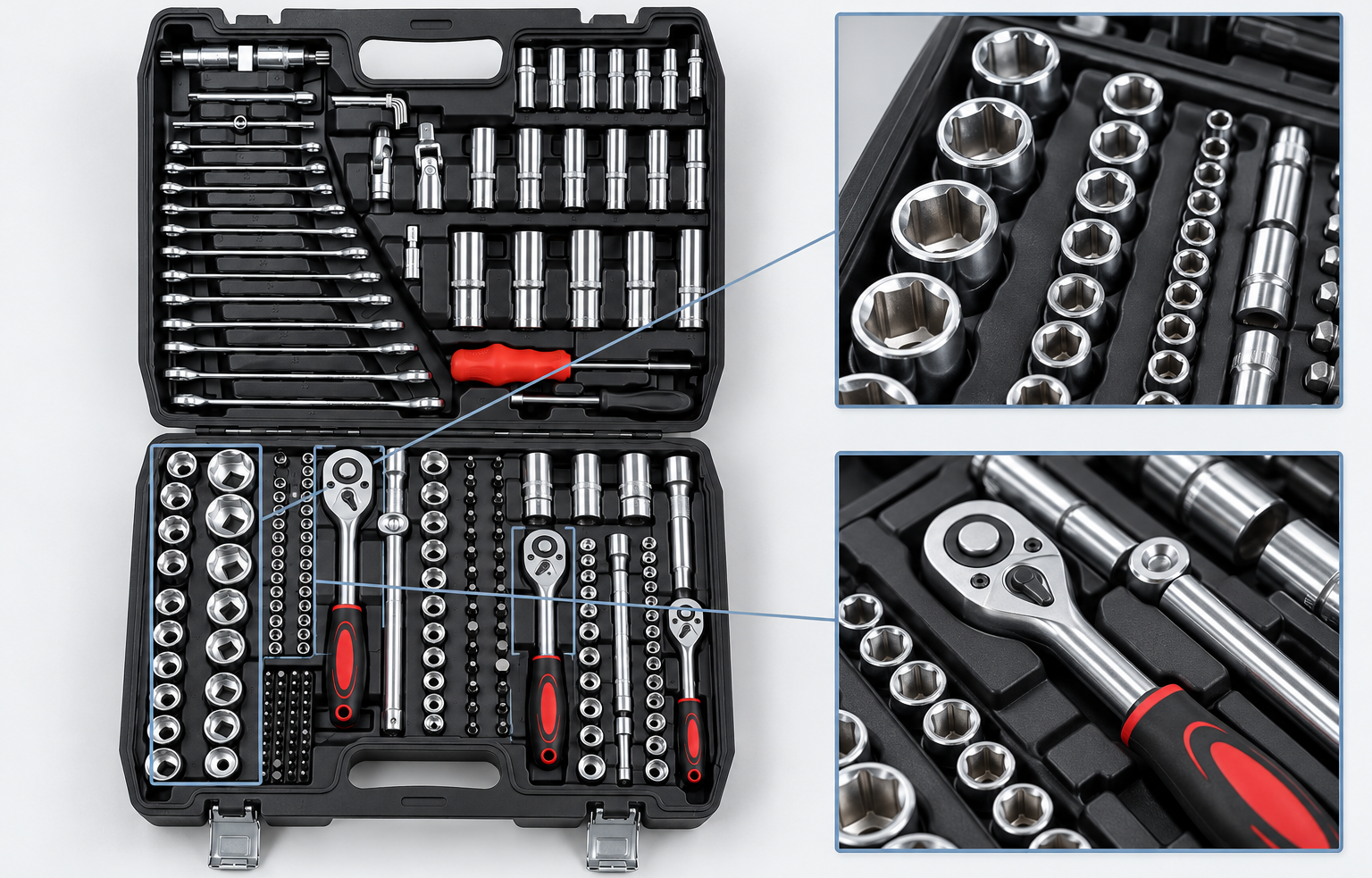
Use one component schedule for supplier discussions, sample approval and packaging review. The checklist below identifies the fields that make each socket distinguishable.
Specification area | What to include in your purchasing brief |
Working sizes and quantities | Every socket opening or bit size, with the quantity of each component |
Drive configuration | The square drive assigned to each socket and accessory |
Working profile | Six-point, twelve-point, hex bit, square bit or other specified profile |
Depth and external dimensions | Overall length, usable internal depth and outside diameter where access matters |
Intended use | Hand-use or impact application, with compatible accessory requirements |
Materials and performance | Agreed steel specification, heat-treatment requirements and relevant acceptance tests |
Markings and finish | Size identification, brand marking, finish requirements and marking durability |
Packaging and documents | Case layout, contents list, artwork, instructions and agreed inspection records |
Example of a Socket Specification Format
17 mm opening; 1/2-inch square drive; six-point; deep; impact-rated; overall length, usable depth and outside diameter defined on the approved drawing.
Check Before Approving the Sample
• Profile: Distinguish external hex, hex bit, square bit and external Torx tools in the component list.
• Inspection: Agree on dimensional checks, tool fit, strength testing, finish quality, marking legibility and complete-set verification.
• Revision control: Keep the sample, drawings, component list and packaging artwork aligned when a size or case position changes.
FAQ
Is a 3/4 socket the same as 19 mm?
Not exactly. 3/4 in. equals 19.05 mm, so your 3/4 in. socket will fit a 19 mm bolt head, but the two sizes are 0.05 mm apart. That gap is fine for hand work. For high torque, use the matching 19 mm socket. You should also check whether 3/4 in. means the opening size or the square drive size.
What can I use instead of a 20mm socket?
Your best substitute is a 20 mm combination wrench or an adjustable wrench set to 20 mm across the flats. Do not reach for SAE sizes. 25/32 in. is 19.84 mm and will not seat; 13/16 in. is 20.64 mm and rounds your corners. You can use locking pliers for low-torque work only.
What can I use if I don't have a 10mm socket?
Use a 10 mm combination wrench. It fits the same fastener, and it is the size most shops already stock. 10 mm across flats is the standard head size for M6 hex bolts under ISO 4014. You can also set an adjustable wrench to 10 mm. Avoid 13/32 in. at 10.32 mm, which is loose and rounds your corners.
What is the most commonly misplaced socket size?
10 mm. No published survey proves it, so treat this as shop consensus rather than data. The size fits more fasteners than any other, you pull it out constantly, and its small round body rolls into gaps. Mark your sockets and keep a spare 10 mm in your drawer.
Final Thought
Planning an OEM or private-label automotive socket set? Share your target market, sales channel and intended applications with Diversitech Global. Include your proposed size list or an existing set reference, and identify the configuration questions you still need to resolve. You do not need a finished specification to send an enquiry.


Comments