Wrench vs Pliers: Key Differences and When to Use Each


In Wrench vs Pliers, the right choice depends on whether you need to turn a matched fastener or grip a workpiece. Pliers on a hex bolt can slip and round the corners; forcing a wrench onto an irregular part can lose grip and damage the workpiece. This guide explains each tool’s physical design, the key differences, and how to choose by task.
What's a wrench?
A wrench is a hand tool used to tighten or loosen nuts, bolts, and fittings. Its shaped head fits the fastener, and moving the handle turns it.
Structure: A handle or shank ends in an open jaw, closed ring, adjustable jaw, or socket interface.
How it works: You push or pull the handle; the fitted head bears on the fastener faces and turns the nut, bolt, or fitting.
Core principle: A wrench transfers hand force into rotation through a contact surface matched to the fastener. Unlike pliers, its head seats on the fastener rather than closing around a workpiece.
Common types of wrenches: An open-end wrench turns nuts or bolt heads with accessible flats; a combination wrench uses its open end for quick access or its ring end for fuller contact; an adjustable wrench changes its jaw opening to turn different-size hex fasteners; a socket wrench reaches nuts or bolts in recessed or obstructed spaces; a pipe wrench grips and turns round pipe or threaded pipe fittings; a torque wrench tightens nuts or bolts to a specified torque, helping prevent over-tightening or under-tightening.
Fit check: Match the wrench type and size to the nut, bolt, or fitting and the available access space; a loose fit can slip or damage the fastener.

What's a plier?
Pliers are hand tools for gripping, holding, pulling, bending, or cutting a workpiece. Squeezing their handles closes pivoted jaws around the part; the jaw shape determines the task.
Structure: Two handles connect at a pivot, with working jaws at the opposite end; some models add grooves, a locking adjustment, or cutting edges.
How it works: Squeezing the handles transfers hand force through the pivot to close the jaws on the workpiece. The jaws may hold the part, reach into a narrow space, or shear a rated material at the cutting edges.
Core principle: Pliers apply closing or cutting force directly to a workpiece. Unlike a wrench, ordinary pliers do not seat on matching fastener flats to turn a nut or bolt without marking it.
Common types of pliers: Combination pliers grip, twist, and bend general parts; long-nose pliers reach and position small parts in confined spaces; groove-joint or water-pump pliers adjust to grip different-size round or flat workpieces; locking pliers clamp a part and hold the jaws locked; diagonal-cutting pliers shear wire within their rated material and diameter.
Fit check: Match the jaw profile and opening to your part; for cutting, check the tool’s stated wire/material type and diameter rating.
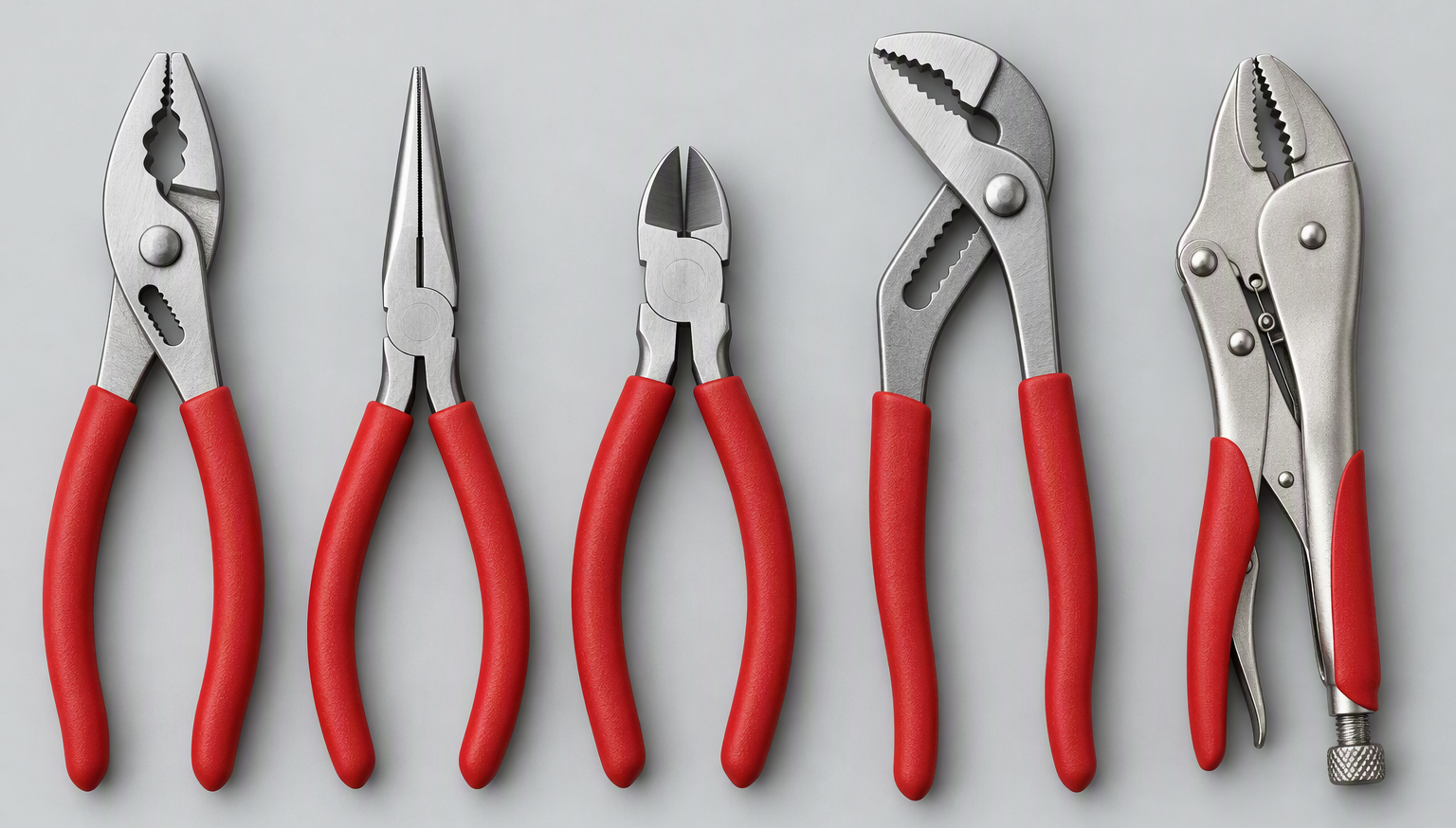
What’s the difference between a wrench and pliers?
Structure
A wrench is usually one solid piece of steel: you hold a single handle, and at the other end sits the working head — an open jaw, a closed ring, an adjustable jaw, or a square drive that accepts sockets. Because this head does not open or close while you work, it can press evenly on the flat sides of a nut or bolt as you turn the handle.
Pliers work like a pair of scissors: two handles are joined by a pivot pin, and the jaws sit at the opposite end. When you squeeze the handles together, the pivot makes the jaws close and grip the part; some pliers also add cutting edges near the pivot or a locking screw that keeps the jaws closed without continuous hand pressure.
The wrench head is fixed and shaped to fit a fastener, so it is built for turning; the plier jaws open and close, so they are built for grabbing many shapes. That is why a wrench feels steady on a bolt, while pliers feel flexible on wire, pins, and odd-shaped parts.
Contact and Force
When you push or pull the handle, the fitted head bears against the flat sides of the nut, bolt, or fitting and turns it around its axis — the handle works as a lever, and a longer handle makes a tight fastener easier to turn.
When you squeeze the two handles, the pivot pin multiplies your hand force and sends it into the jaws, so the jaws clamp, hold, bend, or cut the part; the force squeezes the workpiece instead of turning it.
A wrench delivers turning force for nuts, bolts, and fittings; pliers deliver gripping or cutting force for workpieces. If your job is to turn something, choose the wrench; if your job is to hold, bend, pull, or cut something, choose pliers.
Fit and Jaw Design
The opening or ring of a wrench has a fixed shape and size, and it must match the flats of your nut or bolt the way a key fits a lock; if the size is wrong, the head rides on the corners instead of the flats and can slip.
Pliers' jaws close around the outside of a workpiece, and the tooth pattern or jaw shape decides what they can hold — flat parts, round pipe, small pins, or wire. Because the jaws bite into the surface, they can leave marks on finished or polished parts.
Adjustable pliers can open to many sizes, but that flexibility is not the same as a correctly sized wrench seating squarely on hex flats; gripping a bolt with pliers remains a compromise, not a proper fit.

Material and Heat Treatment
Wrench material: Many wrenches are made from alloy steel such as chrome-vanadium steel, then forged and heat-treated so the head resists twisting or breaking when you apply strong turning force. The exact steel grade and treatment vary by model, so read the specification instead of assuming all wrenches are equal.
Pliers material: Pliers are also commonly made from tool steel such as chrome-vanadium steel, but their working parts face different stress: the jaws must grip without slipping, and cutting pliers need cutting edges harder than the rest of the body. Some models harden only the cutting edges or gripping teeth.
Why it matters to you: The word “steel” alone tells you little. When you compare tools, check the stated steel grade, the heat treatment, and — on cutting pliers — the cutting-edge hardness, plus surface finish and handle coating, because these decide whether the tool keeps its grip and its edge under repeated use.
Wrench vs Pliers: How to Choose by Applications
Feature | Wrench | Pliers | Best choice |
Main purpose | Turns nuts, bolts, and fittings | Grips, holds, bends, pulls, or cuts materials | Choose by the task |
Contact surface | Fits the flat sides of a fastener | Clamps around a workpiece with jaws | Wrench for flats; pliers for irregular shapes |
Force applied | Controlled turning torque | Gripping and squeezing force | Wrench for tightening or loosening |
Best for | Matched-size hex fasteners | Wire, pins, clips, and small parts | Use the tool designed for the material |
Main risk when misused | A poor fit can round a fastener | Jaws can slip, mark, or damage a nut or bolt | Do not use pliers as a substitute for a correctly sized wrench |
Hex Fasteners
Nuts, bolt heads, and hex fittings call for a wrench because the matching faces control rotation without relying on jaw pressure. Use a combination wrench, adjustable wrench, or socket only when its size and access suit your fastener; do not use pliers as the normal tightening tool.
When purchasing, confirm the size range and whether your set covers the fastener sizes your customers or technicians actually handle.
Pipe and Fittings
Round pipe and threaded fittings may need a pipe wrench or adjustable water-pump pliers when you require a strong exterior grip. A standard wrench is still the better choice for hex flats on a fitting, while pliers should not be treated as a universal pipe tool.
For a quotation or sample, specify the target pipe diameter, jaw opening, and whether tooth marks on the finished surface are acceptable.
Small Parts and Wire
Small clips, pins, thin metal, and wire favor pliers because you can grip, pull, bend, or reach into restricted space. Use long-nose pliers for access, combination pliers for holding and bending, and a rated cutting or stripping tool when the operation is cutting or stripping.
Before ordering, match the jaw profile or cutting rating to your material instead of buying one general-purpose tool for every task.
Tool Kit Planning
A practical repair kit needs wrenches and pliers because fasteners and irregular parts demand different contact methods. A wrench and pliers pairing should start with the common fastener sizes and repair operations in your market, then combine matched wrenches with the pliers jaw types your users need.
When buying a kit, review the included sizes, individual tool functions, case layout, and sample fit before you approve a configuration.
FAQ
What are the three types of wrenches?
The three types are open-end, box-end, and combination wrenches. Choose by the access you have and the force you need. Use your box end on tight or corroded fasteners; more contact points resist rounding. Use the open end only where you must reach from the side, and seat its jaw flat first. A combination wrench gives you both.
What are the three types of pliers?
The three types are slip-joint, long-nose, and cutting pliers. Choose by the task you do. Slip-joint pliers grip round, square, flat or hex parts, but give you limited torque. Use long-nose pliers when you must reach into tight spots; never bend stiff wire with their tips. Cut wire or pins at right angles with your cutting pliers.
Can I use pliers instead of a wrench?
You should not use ordinary pliers instead of a wrench on nuts and bolts. Their toothed jaws can slip and round off the corners. Use a correctly sized wrench or socket for a secure fit. If your job requires a specific tightening torque, use a torque wrench.
How to tighten loose pliers?
To tighten loose pliers, first check whether the pivot is loose or the locking grip needs adjustment. Adjust a serviceable pivot only as your manual directs, keeping the jaws moving freely. For screw-adjusted locking pliers, release the lock, turn the adjustment screw clockwise, and test the grip. Have worn or damaged joints repaired, or replace the pliers.
Which pliers have a built-in clamp and adjustable jaws?
Locking pliers have adjustable jaws and a built-in clamping mechanism. You set the jaw opening and clamping pressure with an adjustment screw, then squeeze the handles to lock the jaws onto your workpiece. They hold without constant hand pressure. Use the release lever to open them.
Final Thought
Choose the contact method before choosing the tool: matched fasteners need a wrench, while gripping and bending tasks need pliers. Diversitech Global supports private-label tool-kit projects with configurable tool selections and packaging options. Explore private-label tool kits.


The point about pliers slipping on a hex bolt and rounding the corners is a good practical reminder, since jaw shape really does limit how much torque you can apply safely. Matching the tool to the fastener instead of forcing a fit saves both the bolt and your knuckles. On a related note, if you ever need to show someone the difference visually, an AI image editor can create a revised version of a photo from a written instruction, letting you upload a picture, describe the change, and download the result to review.