Cordless Drill vs Corded Drill: Power, Runtime & Best Uses

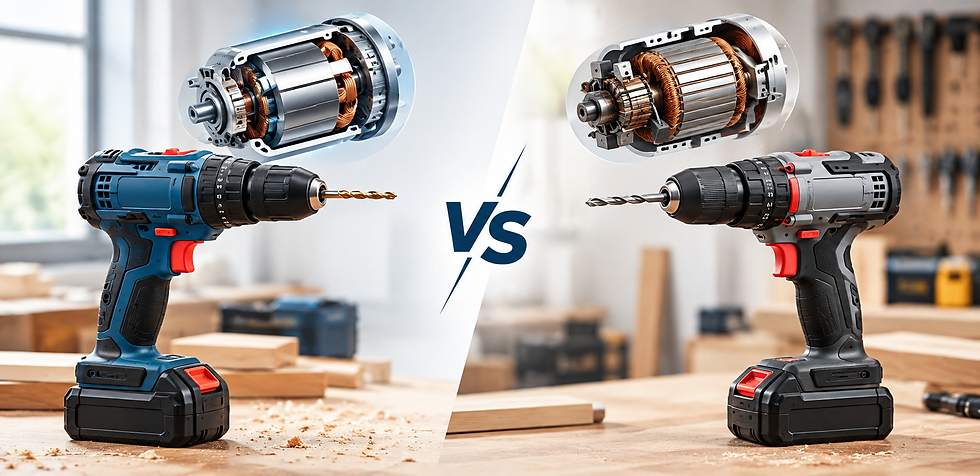
Choosing a cordless drill or corded drill depends on your work requirements and environment. Choosing the wrong electric drill may lead to insufficient power, frequent charging and reduced work efficiency. This article will help you understand the differences and help you make a more suitable choice.
What Is a Cordless Drill?
A cordless drill is a battery-powered drill/driver. This definition of a cordless drill matters because the battery gives you mobility, while the chuck lets you use a drill bit or driver bit. You can use a driver bit for screws, a twist bit or hole saw for suitable wood or metal, and a hammer-drill model with a carbide-tipped masonry bit for suitable brick or concrete work. Check that the shank fits your chuck and that your drill manual allows the material and hole size.

What Is a Corded Drill?
A corded power drill uses outlet power through a cable and plug. Your plug-in drill can keep running without battery swaps, so it suits repeated drilling when a safe outlet is nearby. You can fit the same basic drill bits, driver bits or hole saws that your chuck and manual permit; disconnect the plug before changing accessories.
“Wired drill” and “cord drill” are informal names for the same category. A corded electric drill is not automatically stronger than every cordless model. For your job, compare the rated drilling capacity, speed range, chuck, side handle and intended duty before you choose.

Corded vs Cordless Drill: Practical Differences
When choosing between a corded and cordless drill, choose cordless for mobility and corded for continuous work. The table gives you the fast answer; the sections below explain the conditions that change the choice.
Power and Uptime
A cordless drill runs from stored battery energy, so runtime changes with battery capacity, battery condition and drilling load. A corded drill draws power as long as it stays plugged in, so it has no battery-charging pause; however, the rated capacity and duty cycle still limit its work. If charging interruptions are unacceptable, a corded drill is usually the simpler choice.
Mobility and Setup
A cordless drill has no mains cable during use, so you can move between rooms, ladders, roofs or service points without rerouting a cord. A corded drill remains tied to an outlet, and its working range depends on the cable and approved extension-cord route. When your work moves frequently, a cordless drill is usually more practical.
Safety
A cordless drill removes the live mains cable from the work area, but its battery and charger still require correct handling. A corded drill requires plug and cable inspection, suitable extension-cord routing and ground-fault protection where required. Both drills must be disconnected from power before accessory changes, and both require a secured workpiece. If cable control is difficult at your worksite, a cordless drill reduces that setup issue.
Corded drill vs Cordless drill: How to Choose by Applications
Choosing between a corded and cordless drill largely depends on your project's power needs and working location. Here is a breakdown of common applications to help you make the right choice.
Screwdriving and Assembly
Cabinets, furniture, shelving and elec
trical-box mounting favor a cordless drill. You can carry it between work points, match the driver bit to your screw recess, and use the clutch to reduce over-driving. When purchasing, check that the chuck accepts your common drill and driver bits and that the kit includes compatible batteries and a charger for your planned workload.
Bench Drilling
Repeated holes at a bench or fixture favor a corded drill. Your outlet supplies steady power, and a side handle can help you control larger bits. Before purchasing, confirm the rated capacity for your material and hole size, the chuck range, side-handle inclusion and the extension-cord requirement shown on the tool nameplate.
Remote Repairs
Fence repairs, roof details and work away from an outlet favor a cordless drill. A cordless drill is the better choice only when its battery system can finish your expected holes and fasteners. For purchasing, compare complete kits by compatible spare-battery availability, charger input and whether the included case can carry the bits your field work needs.
Long Sessions
Long drilling in wood or metal near a safe outlet favors a corded drill. It removes charging logistics, but you still need the correct speed, pressure and chip clearing; concrete may require a hammer drill or rotary hammer. When requesting a quote, specify your material, maximum hole size, bit type, operating voltage and required side handle so suppliers can match the correct model.
FAQ
Can I use a cordless drill for concrete?
Yes, a cordless hammer drill with a hard alloy head can drill small holes in concrete. Standard cordless drills without hammering may encounter difficulties, especially in dense concrete. For larger, deeper or repetitive holes, use a rotating hammer with a compatible drill bit. Check the rated concrete capacity of the tool instead of choosing it solely based on the battery voltage.
What is the best way to drill into a solid wall?
Match your drill and bit to the wall material. Check for hidden cables, pipes, and reinforcement first. Use a hammer drill for sound brick or a rotary hammer for dense concrete. Start slowly, keep the drill square, and follow your anchor’s hole-size and depth instructions. Use silica-dust extraction and eye/hearing protection; stop at unexpected resistance.
Can you turn a cordless drill into a corded drill?
Sure, but it is not recommended to directly convert a regular cordless electric drill into a corded one. Theoretically, continuous power supply can be provided to the electric drill by connecting an external power source that meets the voltage and current requirements. However, this usually involves issues such as power conversion, voltage matching, current output, interface modification, and overload protection.
Final Thought

For cordless drill vs corded drill decisions, choose cordless for mobile work and corded for long work near an outlet. Diversitech Global supports brands with OEM/ODM power-tool engineering, custom drill-kit configurations and coordinated quality control.


Comments