Impact Driver vs. Drill: The 2026 Definite Guide

Choosing between an impact driver vs. drill for industrial project applications is crucial. The wrong tool can lead to insufficient torque, damaged fasteners, reduced productivity, and increased operating costs. Our 2026 definite guide breaks down the torque, efficiency, and applications to help you choose the right tool.
What is a power drill?
The electric drill is the most common power tool on the market, primarily used to drill holes of various sizes. The power drill converts electrical energy into rotational mechanical energy through the motor, driving the drill bit to rotate at high speed to complete the cutting process.

Structure of a Drill
Motor of a drill
The Motor is the core component of power. The type of motor determines the rotational speed, torque and working efficiency of the power tool. The drills available on the market use two types of motors: Brushed and Brushless.
Comparison | Brushed Motor | Brushless Motor |
Core Structure | Rotor + Stator + Carbon Brushes + Commutator | Rotor + Stator + PCB Controller + Hall Sensor |
Commutation Method | Mechanical commutation through physical contact between carbon brushes and commutator | Electronic commutation controlled by PCB and MOSFET technology |
Energy Conversion Efficiency | Approx. 60–75% due to friction loss between brushes and commutator | Approx. 80–90% with reduced mechanical friction and heat loss |
Motor Control System | Direct current control through mechanical switching, without an electronic control module | Equipped with PCB controller + MOSFET + Hall Sensor for precise speed and torque control |
Typical Speed (RPM) | Approx. 500–1500 RPM | Approx. 500–2000+ RPM |
Torque Output Range (Cordless Drill) | Approx. 10–50 Nm, suitable for light-duty drilling and DIY applications | Approx. 30–120+ Nm, suitable for professional drilling and heavy-duty applications |
Manufacturing Cost | Lower cost due to simple structure and fewer components | Higher cost due to advanced electronic components and manufacturing process |
Typical Applications | Entry-level cordless drills, household tools, DIY projects, and budget-friendly products | Professional cordless drills, industrial tools, construction applications, and high-performance products |
Gearbox
The gearbox is responsible for regulating the motor's speed and torque output. The power drills available on the market have multi-speed gear systems:
Low Speed: Offers higher torque, suitable for large-sized drilling and screw fastening.
High Speed: Provides higher rotational speed, suitable for rapid drilling.
Battery & Electronic Control System
Cordless drills usually adopt Lithium-Ion batteries and are equipped with BMS (Battery Management System) to prevent overcharging, overdischarging, overheating and improve Battery life.
What is an impact driver drill?
An impact drill driver is designed for high-torque fastening operations. An impact drill converts the Rotational power generated by the motor into a higher-intensity intermittent Impact torque through the Rotational Impact Mechanism.
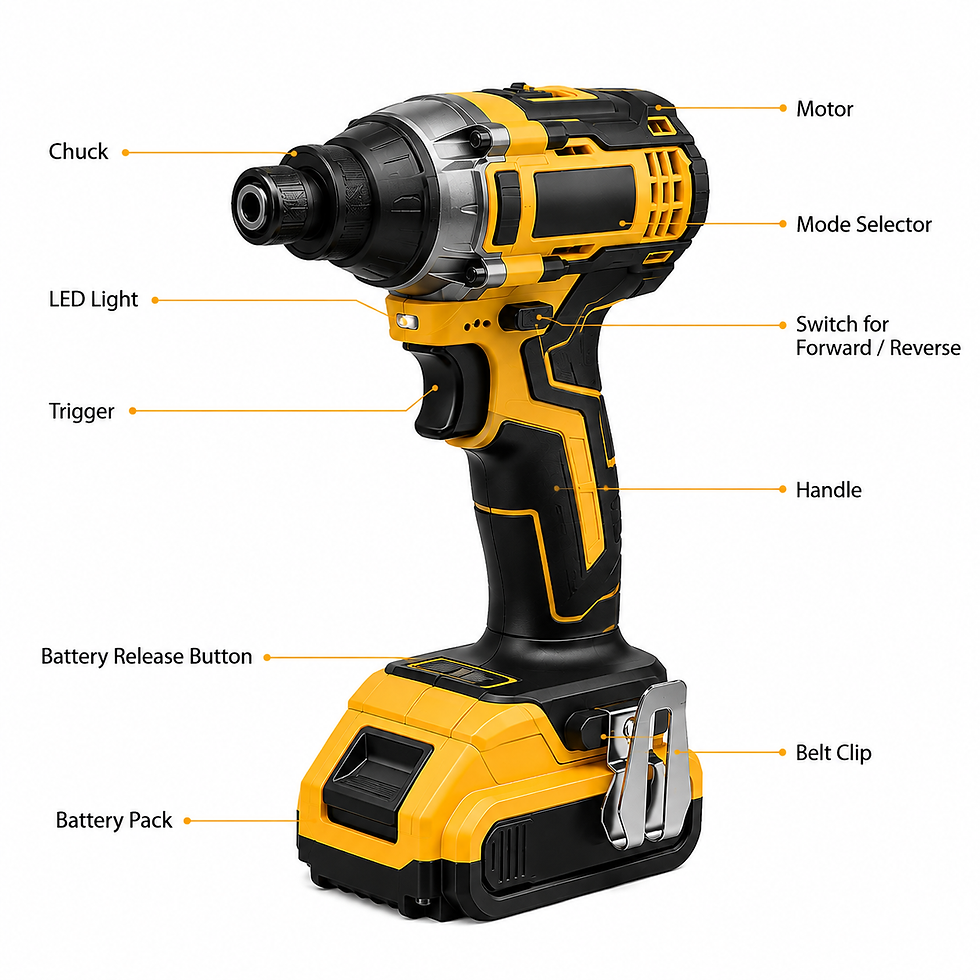
Structure of an Impact Drill Driver
Brushless Motor
The Impact drill driver adopts a brushless motor. The working environment of an impact drill has to withstand higher impact forces. The Brushless Motor has a higher energy conversion efficiency and a more stable torque output during construction.
Planetary Gear System
The compact gear system reduces the high-speed rotation and increases output torque. High-quality impact drills usually adopt a metal gear structure to withstand high-load working environments.
Hammer and Anvil Mechanism
The Hammer and Anvil Mechanism inside the impact drill driver will generate rapid rotational impacts when the load increases, transferring additional energy to the output shaft.
Difference Between Drill and Impact Driver
To help you choose the most suitable tool, it is important to understand the differences between an impact driver and a drill.
1. Torque and Power
Impact Drill Driver: High torque output is the greatest advantage of the impact drill driver, which can handle the installation of long wood screws, the tightening of large-sized bolts and the connection of heavy structures that are difficult for ordinary drills to complete.
Power Drill: The drill provides stable rotational force, but it lacks "explosive power" when dealing with hard materials or high-load tasks. Forcing its use can cause motor overload.
2. Precision and Control
Power Drill: If you request high precision, a drill is your first choice. The power drill does not generate additional impact force. It’s smoother and has better control when you operate the drill.
Impact Drill Driver: The original design intention of the impact drill was not for precision. The sudden burst of high torque in an impact drill is difficult to fine-tune. When conducting fine assembly or handling fragile materials, it is easy to cause screw breakage or workpiece damage.
3.Versatility
Power Drill: A standard drill is very versatile. You can replace different types of drill bits for wood drilling, metal turning, plastic processing, screw installation and furniture assembly. It's the best power tool for DIY.
Impact Drill Driver: It adopts a 1/4-inch hexagonal quick-change chuck. This design makes it convenient to replace the bit head, but only accessories with hexagonal handles can be used.
4. Operator Comfort
Power Drill: When using a Power Drill, it is quiet and smooth. If you use it continuously for assembly or drilling tasks for a long time, a power drill is more comfortable and less likely to cause fatigue.
Impact Drill Driver: When using the impact drill driver, the sound is loud, the vibration is obvious, and long-term operation is more likely to cause fatigue. If long-term operation is required, we recommend wearing a hearing protection device.
5. Efficiency & Cam-out Prevention
Impact Drill Driver: Preventing cam-out is the advantage of an impact drill. The pressure generated by the impact enables the screwdriver bit and screw bit to mesh precisely, reducing the phenomenon of thread slippage, thereby extending the service life of the screwdriver bit and protecting the fasteners.
Power Drill:
Under high-torque tasks, a standard drill is highly prone to cam-out, which can damage the screw head.
Impact Driver vs. Drill: When to Use for Different Fastening Tasks

Typical Applications for Drill
Woodworking and Furniture Assembly
In furniture manufacturing and woodworking, a drill is your top choice. Drill helps you drill precisely, control the depth of the holes, and avoid damaging the wood surface.
Diversitech Global recommends you equip an Adjustable Clutch Drill. Sell drill in combination with woodworking drill bit sets and batch head sets.
Metal Drilling Applications
The drill is also suitable for light Metal processing. When combined with HSS Drill Bit or Cobalt Drill Bit, it can process Carbon Steel, Aluminum, and thin metal sheets.
Typical Applications for Impact Driver
Construction and Structural Installation
The construction field is one of the main application markets of Impact Driver. In construction applications, a large number of long screws need to be installed. Ordinary drills are prone to insufficient torque or the screwdriver head slipping off. The Impact driver can quickly achieve high-strength fastening through impact torque.
When purchasing an impact driver, you should focus on the torque parameters, IPM, brushless motor solution, and dust-proof and shock-proof design of the impact driver. If you are targeting the European and American markets, please pay attention to the CE, RoHS, UL/ETL certifications of the manufacturer.
Automotive and Industrial Repair
Automobile maintenance and industrial maintenance usually involve a large number of high-resistance fasteners. The instantaneous Impact output of the Impact Driver can reduce the difficulty of disassembly and improve maintenance efficiency.
For car maintenance, Diversitech Global suggests you choose a high-torque Impact Driver. “Impact Driver + Socket Set + Bit Set” is the most recommended combination tool set, which meets the one-stop purchasing needs of professional maintenance users.
Looking for a Reliable Power Tool Set Supplier for Your Business? Contact Us.
FAQ: Impact Driver vs. Drill – Everything You Need to Know
What is the most popular size impact driver?
The 1/4-inch hex collet is always recognized as the most popular size for impact drill in the global hardware market. This size design not only facilitates quick bit head switching but also perfectly fits most high-strength, impact-grade accessories on the market. This electric impact drill driver is a standard configuration in woodworking construction and general decoration. In addition, the 1/4-inch brushless impact drill driver on the 18V or 20V platform is currently the core-demand variety in the overseas market. Because it ensures a strong torque output while maintaining excellent portability, it can easily handle various operation requirements ranging from furniture assembly to frame construction.
What size impact driver do I need for lug nuts?
For removing automotive lug nuts, a standard 1/4-inch impact driver is typically insufficient. You need an impact wrench with a 1/2-inch square head drive structure. Impact driver vs drill emphasizes the tightening speed, but the tire nut requires an extremely high torque output to loosen, which is far beyond the torque range of the ordinary impact drill driver.
Can I use my impact driver as a hammer drill?
An impact drill cannot be used instead of a hammer drill. hammer drill is mainly used for processing stone and drilling holes in concrete. hammer drill generates a forward striking force and breaks the concrete surface through high-frequency vibration, while an impact drill generates a tangential impact force along the rotation direction, aiming to enhance the twisting torque. Using the impact drill driver instead of the hammer drill will damage the impact drill and cause the motor to overheat and burn out.
Why do impact drivers handle long lag bolts better than powerful drills?
The impact drill driver and power drill generate torque in different ways, so the impact drill is more suitable for installing long lag bolts and large fasteners. A power drill relies on the motor to continuously output rotational torque, while an impact drill generates high-frequency rotational impact force through the internal impact mechanism and can continuously release high torque. When you choose an impact drill, pay attention to the Motor type (such as a brushless motor), maximum torque output, impact frequency, battery platform compatibility, gearbox structure and stability under long-term load.
Final Thought
Diversitech Global offers customized OEM/ODM solutions for both high-torque impact drivers and precision drills. Our product line covers household tools, auto repair tools, and professional power tools. With over 25 years of industry experience, we create the most competitive tool sets for you.


Lần đầu truy cập https://kp88.art/ mình khá chú ý đến cách giao diện được bố trí và phân chia các khu vực. Tổng thể trang có thiết kế thoáng, các danh mục được sắp xếp tương đối hợp lý nên việc tìm kiếm và theo dõi thông tin khá thuận tiện. Thao tác chuyển đổi giữa các trang ổn định, nội dung hiển thị rõ ràng và không tạo cảm giác rối mắt. Dù mới trải nghiệm ở mức cơ bản, mình thấy giao diện nhìn chung khá gọn gàng và dễ làm quen.
Mình cũng từng thấy e39 được nhắc trong vài cuộc thảo luận nên tò mò vào xem thử. Ấn tượng đầu tiên là giao diện khá gọn, các mục được sắp xếp tương đối dễ nhìn.
This nicview family app blog is amazing, thankyou for sharing this blog with uss!! really imformative........
Spent a couple hours on Pokiig last week going through the puzzle section. A few of the games were more engaging than I expected — kept telling myself one more level and then lost track of time.