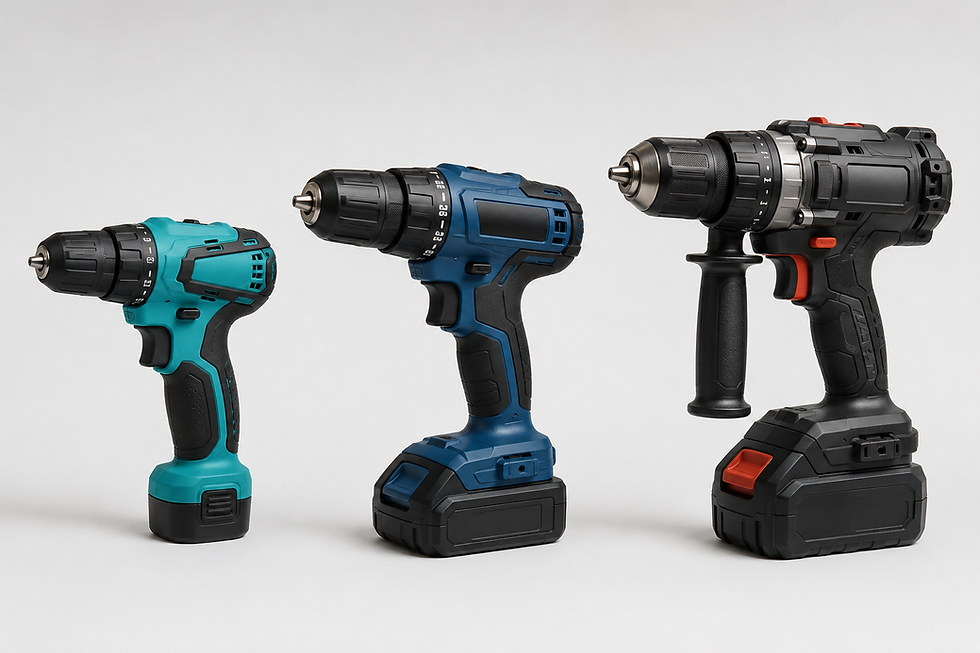
4V Cordless Drill Comparison: Economy, Certified, and Premium Professional Models
Updated: Jul 8

The 4V cordless drill is a popular type of cordless drills in the retail and gift tool markets. Although different drill types look similar, their internal configurations, quality, and safety differ significantly. This article will provide a comprehensive comparison of the economy, certified, and high-end professional models to help you choose the most suitable solution.
What Is a Generic 4V Cordless Drill?
Entry-level 4V electric drills are mainly targeted at price-sensitive markets. These types of drills typically feature a common plastic casing, brushed motors, and entry-level lithium batteries, and have not passed international certification tests such as CE and RoHS. The greatest advantage lies in the low cost.
What Does CE & RoHS Certification Mean?
For 4V cordless drills, CE and RoHS are not merely certification marks on the product packaging, but also represent that cordless drill driver complies with international market regulations in terms of safety, electromagnetic compatibility (EMC), and environmental protection requirements. CE and RoHS are important thresholds for entering the European market and also the basis for determining whether a supplier has the ability to supply goods to the international market.
CE certification proves that the design, manufacture and testing of the product comply with EU standards. Those types of cordless drills make it easier to enter the European market for sale and can reduce the customs clearance risks caused by the product not conforming to local regulations.
The RoHS certification mainly focuses on the environmental performance of cordless drill drivers. For Europe and an increasing number of countries implementing environmental protection regulations, RoHS certification means that the materials such as circuit boards, batteries, chargers, and electronic components used in electric drills complies with the requirements of EU environmental protection regulations.
What Is a Premium Professional Drills?
The Premium Professional 4V drill is positioned in the high-end and professional market and is a top-rated drill. Compared to the previous two types of drills, it uses higher-end battery cells and is suitable for high-frequency operations and professional installation work.
4V Cordless Drill Comparison: Entry-Level vs CE & RoHS Certified vs Premium Models

1.Drill Housing
Entry-level 4V small cordless drills typically use PP+TPR material for the casing. TPR material is used for the handle overlay. PP material is lower in cost and lighter. The impact resistance and heat resistance of this material are relatively weak. Therefore, after transportation, dropping and long-term use, the battery powered drills are prone to cracking and deformation.
Cordless drills with CE and RoHS standards usually adopt ABS+TPR shells. ABS material has stronger impact resistance, better heat resistance. It can enhance the anti-drop performance of the entire drill driver and also make it easier to meet the environmental protection standards of the European and American markets,Its cost is slightly higher, but it can reduce the rate of transportation damage, after-sales maintenance and customer complaints. Therefore, this type of portable drill is more valuable for purchase.

2.Drill Gearbox
Economy cordless drills typically use plastic gearboxes or a combination of plastic and powder metallurgy gearboxes. Although plastic gears are low in cost, due to the low hardness and wear resistance, they are easier to wear after frequent use, which results in a decrease in torque, an increase in noise, and a shortened service life of the power drill cordless.
In contrast, CE & RoHS standard cordless drill sets generally use full powder metallurgy gearboxes, have higher material density, hardness and size consistency, and can maintain more stable gear meshing. It still maintains stable torque output and a long transmission life during long-term use.For brand owners and wholesalers, this material is slightly more expensive, but effectively reduces the rate of after-sales repairs.

3.Cordless Drill Motor
The 380 motor is the most common brushed motor in 4V electric screwdrivers and drills. However, even among 380 motors, performance can vary significantly. Basic drills on the market use copper-clad aluminum (CCA) winding 380 motors. The conductivity of this motor is extremely low and its resistance is relatively high. It is easy to heat up after continuous use, resulting in a decrease in rotational speed and torque attenuation.
CE & RoHS certified drills use pure copper winding 380 motors. These types of cordless drills have higher conductivity and better heat dissipation, allowing for more stable speed and torque output during continuous drilling. The pure copper motors are slightly more expensive which can significantly reduce performance degradation and after-sales issues caused by overheating, making drills drivers more suitable for export markets and branded products.

4.BMS Protection Board
The battery management system (BMS) protection board is the core electronic control component in a 4V cordless drill battery pack, directly affecting battery life, safety, and range stability. Uncertified 4V drills use basic protection boards with charging protection but lacking discharging protection.
Standard electric drill drivers adopt a more comprehensive BMS protection board, featuring multiple safety mechanisms including overcharge, over-discharge, overcurrent, short circuit, and temperature protection. This cordless drill offers more stable power output for the motor. For purchasers, this type of drills means low battery failure rate and after-sales risk.

5.Power Tool Battery Compatibility
For electric drill brand owners, importers, and wholesalers, batteries directly impact product reliability and market competitiveness. The most common electric drill on the market often uses 18650 1300mAh/3C cells, while some battery drills may use recycled or small-factory cells to reduce manufacturing costs. This type of battery causes problems such as rapid voltage drop, power attenuation and shortened battery life when the drill is under high load.
CE-marked cordless drills use 18650 ternary lithium cells (1300mAh/10C) from reputable manufacturers, offering more stable discharge performance and higher rate output. This provides a continuous and stable current to the motor, allowing cordless drills to maintain good power performance even under high load conditions. This electric drill offers the best cost-performance solution that balances performance, quality and cost, and is also the first choice for most brand owners and importers.
The premium professional drills will adopt high-performance battery cells from brands such as Tianpeng, Ewatt, and Sanjie, high-quality battery cells have a higher cost but support higher rate discharge and more charge and discharge cycles. For example, Tianpeng's continuous discharge capacity can reach 45 to 50A, and it offers capacity options ranging from 2.0Ah to 3.0Ah, making it more suitable for heavy-load working conditions. Ewatt, places more emphasis on balanced performance. Its 18650 20P can continuously discharge for approximately 30A while maintaining an internal resistance of ≤18mΩ, which helps to reduce heat generation and extend service life. The 3.0Ah battery cells of Sanjie offer longer battery life while maintaining a lower internal resistance.

4V Cordless Drill Comparison
Spec | Economy Drill | CE & RoHS Certified Drill | Premium Professional Drill |
Voltage | 4V | 4V | 4V |
Max torque | 3.5–4.0 N·m | 5.0 N·m | 6.0–7.0 N·m |
Charging | USB-C, No eco compliance | USB-C, CE & RoHS compliant | USB-C, CE & RoHS compliant |
Battery cells | Typical 18650 1300 mAh / 3C cells | 18650 ternary lithium 1300 mAh / 10C cells from qualified manufacturers. | High‑performance cells with capacity up to 2.0 -- 3.0 Ah. |
FAQ
1.What is a 4V cordless drill best used for?
The 4V cordless drill is suitable for light DIY and daily furniture repairs, such as removing screws, installing curtains, and fixing photo frames, etc. This small cordless drill is lightweight and easy to operate. It is best for home use and for women.
2.How should I charge and store a 4V cordless drill safely?
The correct charging and storage methods can extend the life of lithium batteries. To prevent voltage or current mismatch, it is best for you to charge with the charger provided by the manufacturer. After charging, disconnect the power supply in time and do not charge continuously for a long time. If the electric drill is not used for a long time, place the electric drill in a cool and dry environment, avoiding high temperature, humidity or direct sunlight.
3.What safety tips should beginners know before using a 4V cordless drill?
Safety is the most important for beginners, make sure the drill bit or screwdriver is securely installed before use. It is suggested to wear goggles to prevent wood and metal shavings from splashing into your eyes. When drilling, keep the electric drill perpendicular to the workpiece and avoid excessive force. If the drill gets stuck or there is abnormal vibration during drilling, you should stop working immediately and check. Besides, do not use the electric drill in a damp environment and do not remove the battery at will to avoid electric shock.
4.How can I tell if a 4V cordless drill’s CE and RoHS labels are trustworthy?
The printing of CE or RoHS marks on a product does not prove that it has been certified. The key lies in the CE declaration of Conformity , RoHS test report and third-party test documents provided by the supplier, and verifying whether the product model is consistent with the information in the report.
Final Thought

Now you understand the three levels of 4V electric drills. Diversitech Global is a seasoned Chinese power tool manufacturer. We offer a complete product line ranging from CE/RoHS certified cordless drills to high-end professional drills, and support OEM/ODM customization services to help customers achieve the best balance between quality, performance and cost.


Comments